

26th November 2025
Having recently turned 30, and with the Oscars around the corner, it seemed like exactly the right time to reminisce a little.
From the opulent period dramas of the 90s to the vast, immersive worlds of modern sci-fi, the Academy Award for Best Production Design has consistently celebrated the craft of world-building. Over the last three decades, this award has not just recognised beautiful sets, but the essential role of the Production Designer in shaping a film’s narrative and emotional core.
The period between 1995 and 2025 has been a fascinating journey for the art of cinematic architecture. Early winners like Restoration (1996) and Titanic (1998) showcased the power of meticulous historical recreation, demanding a high level of practical construction and detail. This tradition continued with the fantastical gothic worlds of Sleepy Hollow (2000) and the lush, turn-of-the-century spectacle of Moulin Rouge! (2002), demonstrating the enduring value of tangible, built environments.
The turn of the millennium brought a new challenge: the rise of digital filmmaking. While films like Avatar (2010) and Dune (2022) pushed the boundaries of what could be achieved with CGI and virtual sets, the Production Design Oscar often went to the teams who provided the crucial physical anchor for these worlds. The award consistently recognises the designers who craft the real-world elements – the props, the partial sets, the textures – that ground even the most ambitious digital landscapes in a believable reality.
This is evident in the work of masters like Dante Ferretti, who won for the richly detailed period pieces The Aviator (2006) and Hugo (2012). His work, alongside that of Stuart Craig for The English Patient (1997) and Catherine Martin for The Great Gatsby (2014), highlights a recurring theme: the Academy’s appreciation for the sheer scale and artistry of sets that are physically constructed.
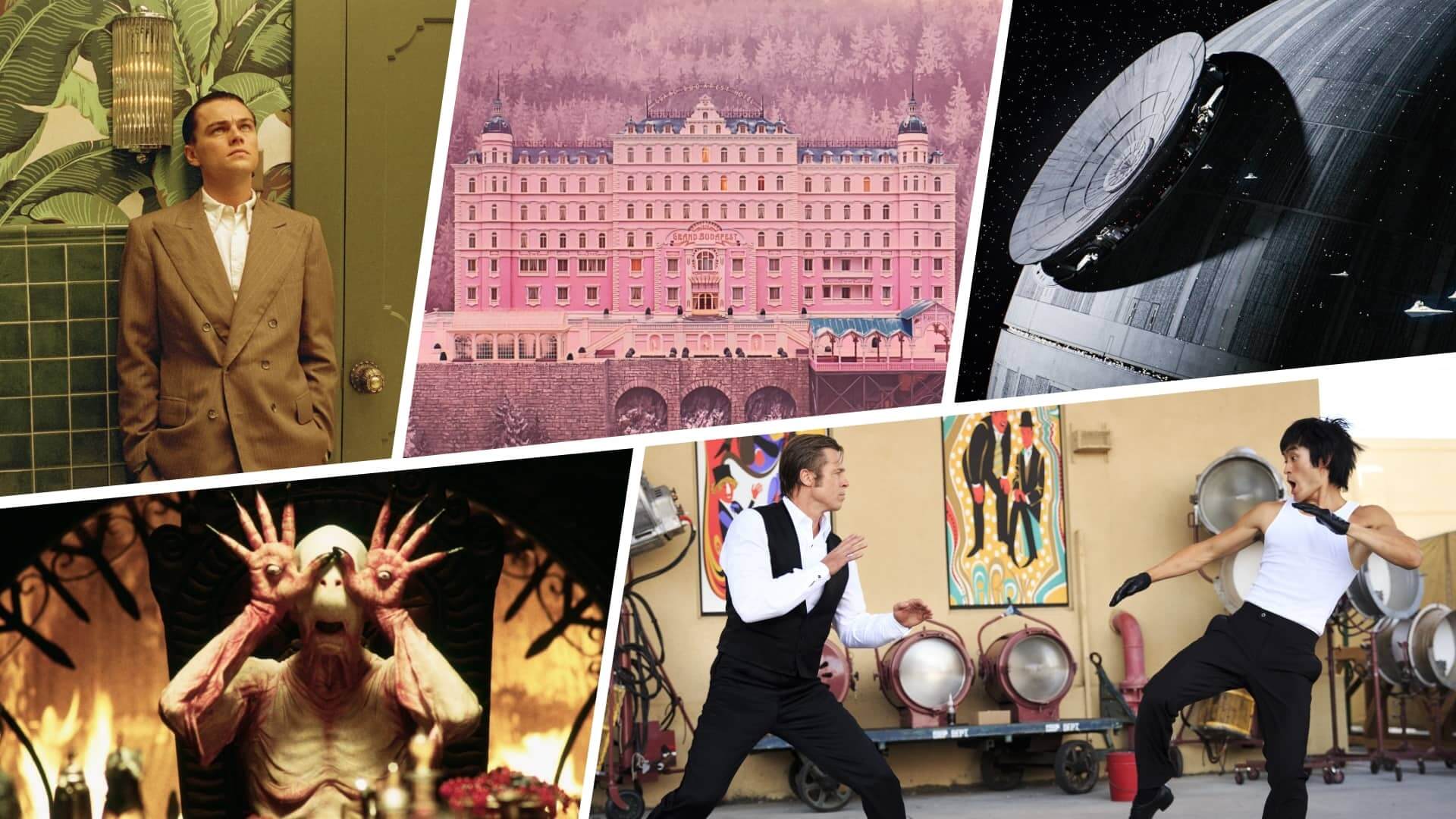
More recently, the award has celebrated bold, highly stylized visions that define a film’s entire aesthetic. The Grand Budapest Hotel (2014) and The Shape of Water (2017) are perfect examples, where the production design is not merely a backdrop but a character in itself, driving the tone and emotion.
The 2019 win for Black Panther (Hannah Beachler) marked a significant moment, recognising the creation of the futuristic, Afrofuturist nation of Wakanda – a triumph of original, culturally-rich world-building. This was followed by the stunning, monochromatic recreation of Old Hollywood in Mank (2021) and the surreal, highly theatrical design of Poor Things (2024). These films prove that whether the setting is historical, fantastical, or a blend of both, the power of a brilliantly conceived and executed physical set remains the bedrock of great cinema.
As set builders, we see this trend as a powerful validation: the most memorable and award-winning worlds are those that start with a strong, tangible foundation.
The Oscar for Production Design is, at its heart, a tribute to the architects who build the dreams we see on screen.
And on that note, let’s all cross our beastly fingers for Frankenstein and do a little dreaming of our own.